


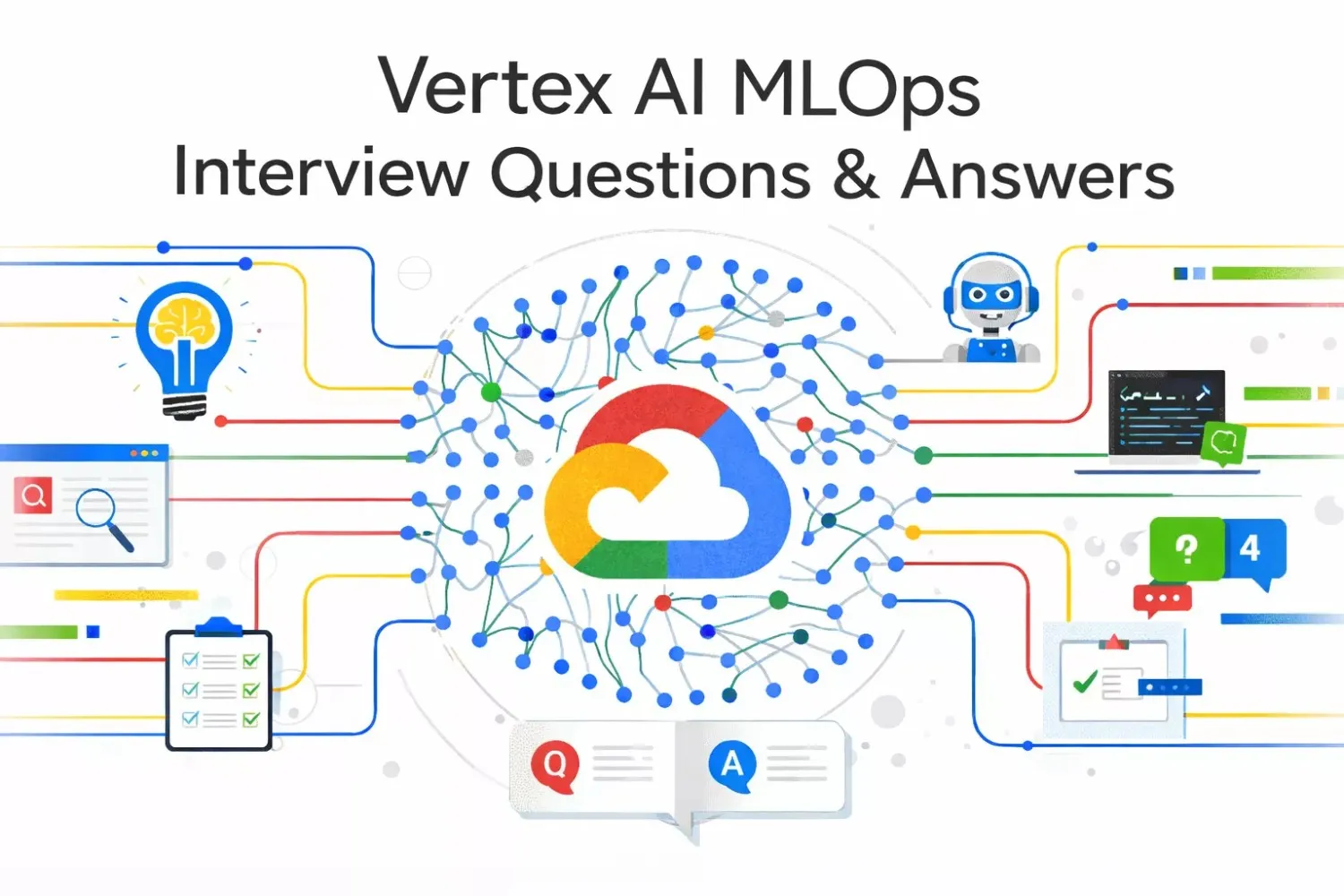
Vertex AI MLOps Interview Questions & Answers Latest 2025
CloudDevOpsJobs.com – Your Gateway to Cloud, DevOps & MLOps Careers
As organizations move ML models from experimentation to production, MLOps on Google Vertex AI has become a high-demand skill. Companies hiring MLOps Engineers, ML Platform Engineers, and Cloud DevOps Engineers expect strong knowledge of Vertex AI pipelines, CI/CD, monitoring, governance, and scalability.

This guide covers real-world Vertex AI MLOps interview questions, aligned with actual job requirements and production-grade ML systems.
Why Vertex AI MLOps Skills Matter for Jobs
Recruiters look for candidates who can:
- Operationalize ML models
- Automate training & deployment
- Handle model drift & monitoring
- Integrate CI/CD with ML workflows
- Secure and scale ML systems
Vertex AI provides a unified MLOps platform combining training, pipelines, deployment, monitoring, and governance.
Vertex AI Fundamentals – Interview Questions
1. What is Vertex AI?
Vertex AI is Google Cloud’s end-to-end machine learning platform that supports:
- Data preparation
- Model training (AutoML + custom)
- Model deployment
- Monitoring
- MLOps automation
It replaces AI Platform and unifies ML workflows.
2. What problems does Vertex AI solve in MLOps?
Vertex AI addresses:
- ML pipeline automation
- Model versioning
- Deployment consistency
- Drift detection
- Scalable inference
- Governance and reproducibility
3. Key components of Vertex AI?
- Vertex AI Workbench
- Vertex AI Pipelines
- Training Jobs
- Model Registry
- Endpoints
- Feature Store
- Model Monitoring
- Vertex AI Experiments
Vertex AI Pipelines – Core MLOps Questions
4. What is Vertex AI Pipelines?
Vertex AI Pipelines is a managed Kubeflow Pipelines service used to:
- Orchestrate ML workflows
- Automate training & evaluation
- Enable CI/CD for ML
5. How are pipelines defined in Vertex AI?
Pipelines are defined using:
- Python SDK
- Kubeflow Pipelines (KFP)
- YAML specifications
Each step runs as a containerized component.
6. How do Vertex AI Pipelines support CI/CD?
- Pipelines can be triggered via Cloud Build
- Git-based version control
- Automated retraining on new data
- Promotion between environments (dev → prod)
Model Training & Deployment Interview Questions
7. Difference between AutoML and Custom Training?
| AutoML | Custom Training |
|---|---|
| No ML expertise needed | Full control |
| Faster experimentation | Custom architectures |
| Limited tuning | Advanced optimization |
8. How do you deploy a model in Vertex AI?
Steps:
- Upload trained model
- Register in Model Registry
- Create endpoint
- Deploy model version
- Configure traffic splitting
9. What is traffic splitting in Vertex AI?
Traffic splitting allows:
- Canary deployments
- A/B testing
- Safe rollout of new models
Example:
- Model v1 → 90%
- Model v2 → 10%
Vertex AI Model Registry & Versioning
10. What is Vertex AI Model Registry?
It is a central repository for:
- Model versions
- Metadata
- Lineage
- Deployment history
Critical for auditability and governance.
11. How does Vertex AI handle model versioning?
- Each upload creates a new version
- Versions tracked with metadata
- Easy rollback to previous models
Feature Store Interview Questions
12. What is Vertex AI Feature Store?
Feature Store provides:
- Centralized feature management
- Online & offline serving
- Feature consistency across training & inference
13. Why is Feature Store important for MLOps?
It prevents:
- Feature skew
- Duplicate feature engineering
- Inconsistent predictions
Monitoring & Drift Detection Questions
14. What is Vertex AI Model Monitoring?
It monitors:
- Input data drift
- Prediction skew
- Feature distribution changes
Alerts are sent via Cloud Monitoring.
15. How does Vertex AI detect data drift?
By comparing:
- Training dataset statistics
- Live inference data
Uses statistical thresholds.
16. What actions do you take after drift detection?
- Retrain model
- Update features
- Adjust thresholds
- Roll back model version
Security & Governance Interview Questions
17. How do you secure Vertex AI workloads?
- IAM roles (principle of least privilege)
- VPC Service Controls
- Private endpoints
- CMEK encryption
- Audit logs via Cloud Audit Logs
18. How does Vertex AI support compliance?
- Model lineage tracking
- Metadata logging
- Reproducible pipelines
- Access control enforcement
Cost Optimization & Performance Questions
19. How do you reduce Vertex AI costs?
- Use batch prediction instead of endpoints
- Auto-scale endpoints
- Choose appropriate machine types
- Stop idle Workbench instances
20. Batch Prediction vs Online Prediction?
| Batch Prediction | Online Prediction |
|---|---|
| Offline | Real-time |
| Cheaper | Higher cost |
| Large datasets | Low latency |
DevOps & Infrastructure Integration
21. How does Vertex AI integrate with DevOps tools?
- Cloud Build for CI/CD
- Artifact Registry for containers
- Terraform for IaC
- GitHub Actions support
22. How do you implement MLOps using Terraform?
- Provision Vertex AI resources
- Create pipelines
- Manage endpoints
- Enforce consistency across environments
Scenario-Based Interview Questions
23. Design an end-to-end MLOps workflow using Vertex AI
Architecture:
- GCS → Data ingestion
- Dataflow → Feature engineering
- Vertex AI Pipelines → Training
- Model Registry → Versioning
- Endpoint → Deployment
- Monitoring → Drift detection
24. How would you handle model rollback?
- Reduce traffic to new model
- Shift traffic to stable version
- Update pipeline to mark failed version
Vertex AI vs Other MLOps Platforms (Interview Angle)
| Platform | MLOps Strength |
|---|---|
| Vertex AI | Best AutoML & data integration |
| AWS SageMaker | Strongest governance |
| Azure ML | Enterprise-friendly UI |
Final Thoughts – Career Perspective
Vertex AI MLOps skills are highly valuable for:
- MLOps Engineer roles
- Cloud DevOps jobs
- ML Platform teams
- Data engineering roles
Understanding automation, monitoring, security, and cost control is what separates junior ML engineers from production-ready MLOps professionals.
 CloudDevOpsJobs.com
Connecting You to Cloud, DevOps & MLOps Careers
Explore more:
- MLOps interview guides
- Cloud DevOps job listings
- Hands-on CI/CD tutorials



Really enjoyed reading this ? it?s nice to see real-world
experience explained clearly instead of just theory. I?ve been working on similar maker-style
projects and found a lot of this relatable.
I keep notes on my own experiments over on WatDaFeck, mainly so I don?t forget what
worked and what didn?t. Thanks for sharing this.