Top DevOps & SRE Tools That Will Drive Job Opportunities in 2026
The cloud era has transformed how software is built, deployed, and maintained. With the rise of automation, microservices, observability, and reliability engineering, DevOps and Site Reliability Engineering (SRE) roles are among the hottest careers in tech — and the tools you master will define your job prospects in 2026. Employers today don’t just want DevOps professionals; they want experts in the right toolchains that speed delivery, boost reliability, secure systems, and simplify operations.
In this article, we explore the most in-demand DevOps and SRE tools that are creating real job opportunities — backed by industry hiring data and trends.

 1. Containerization & Orchestration Tools
Kubernetes
Kubernetes continues to dominate the DevOps landscape as the go-to container orchestration platform. Most modern applications are containerized, and managing them at scale requires Kubernetes expertise. Job postings frequently list Kubernetes as a core requirement for DevOps, cloud, and SRE positions. pr4-articles.com
Docker
Docker remains the foundation for container creation and packaging. While Kubernetes handles orchestration, Docker is essential for container workflows. Medium
Why this matters for 2026 jobs: Drives demand for Kubernetes administrators, DevOps engineers, and SREs. Appears in a majority of cloud-native job descriptions.
 2. Infrastructure as Code (IaC) & Automation Tools
Terraform
Terraform is the leading multi-cloud IaC tool that allows teams to define cloud infrastructure using reusable code. Its ability to work across AWS, Azure, and GCP makes it highly valuable for employers. pr4-articles.com
Ansible
Ansible automates configuration management and deployment — skills that are frequently requested in DevOps roles. cdrelitewriters.com
CloudFormation / Pulumi
These tools native to specific cloud platforms (AWS CloudFormation or Pulumi) help automate infrastructure provisioning, also driving job demand.
 3. CI/CD & DevOps Pipeline Tools
Jenkins
Jenkins has long been a staple CI/CD tool, automating builds, tests, and deployments. It is still widely used in enterprise DevOps workflows. vtricks.in
GitHub Actions & GitLab CI
Modern DevOps teams increasingly rely on GitOps-style pipelines. Tools like GitHub Actions and GitLab CI help automate the full software delivery lifecycle. Medium
ArgoCD & Flux
These GitOps tools enable automated Kubernetes deployments based on declarative configurations — a growing trend in DevOps automation. NareshIT
 4. Monitoring, Observability & Reliability Tools
Prometheus & Grafana
For SRE roles, observability is a must. Prometheus (metrics) and Grafana (visual dashboards) help teams monitor system health and performance. DEV Community
ELK/EFK Stack
Elasticsearch, Logstash (or Fluentd), and Kibana provide powerful logging and troubleshooting tools that SRE engineers use to investigate production issues. DEV Community
Datadog / New Relic
Enterprise employers often use hosted observability platforms like Datadog and New Relic for full-stack monitoring. DEV Community
 5. Security & DevSecOps Tools
Security has become part of the DevOps workflow — especially for organizations with compliance requirements.
Snyk, Trivy, Aqua
These tools scan containers, code, and dependencies for security vulnerabilities during deployment pipelines. DEV Community
HashiCorp Vault
For secrets management (passwords, API keys, tokens), Vault skills are in high demand. DEV Community
 6. SRE-Focused Incident, Alerting & Access Tools
PagerDuty / Opsgenie
Incident response and on-call alerting tools like PagerDuty and Opsgenie are commonly mentioned in SRE job descriptions. Refonte Learning
FireHydrant
A newer tool built specifically for SRE workflows to manage incidents, runbooks, and service catalogs. Ksolves
Backstage & Teleport
Backstage supports internal developer portals, while Teleport enhances secure access — both are increasingly relevant for platform engineering and reliability roles. Medium+1
 7. Emerging Tools with Job Potential by 2026
As systems grow in scale and complexity, new tools are gaining traction:
Dagger — programmable CI/CD pipelines that unify build and deployment automation. Medium ObservIQ — next-gen observability with AI-powered insights. Medium AI-powered SRE Agents — startups like Ciroos are building AI systems to automate incident detection and resolution, creating future-forward roles. Wikipedia
 How Mastering These Tools Boosts Your Career in 2026
These tools are not just buzzwords — they directly influence hiring decisions:
 High Demand: Employers list Kubernetes, Terraform, Jenkins, and Prometheus in most job descriptions. cdrelitewriters.com Career Specialization: Experts in SRE tooling like observability and incident response are among the highest-paid professionals in the cloud space. CareerCartz Cross-Role Value: DevOps skills transfer into platform engineering, cloud architect roles, and even AI/ML operations. devopstraininginstitute.com
 Conclusion: Focus on Tools That Matter in 2026
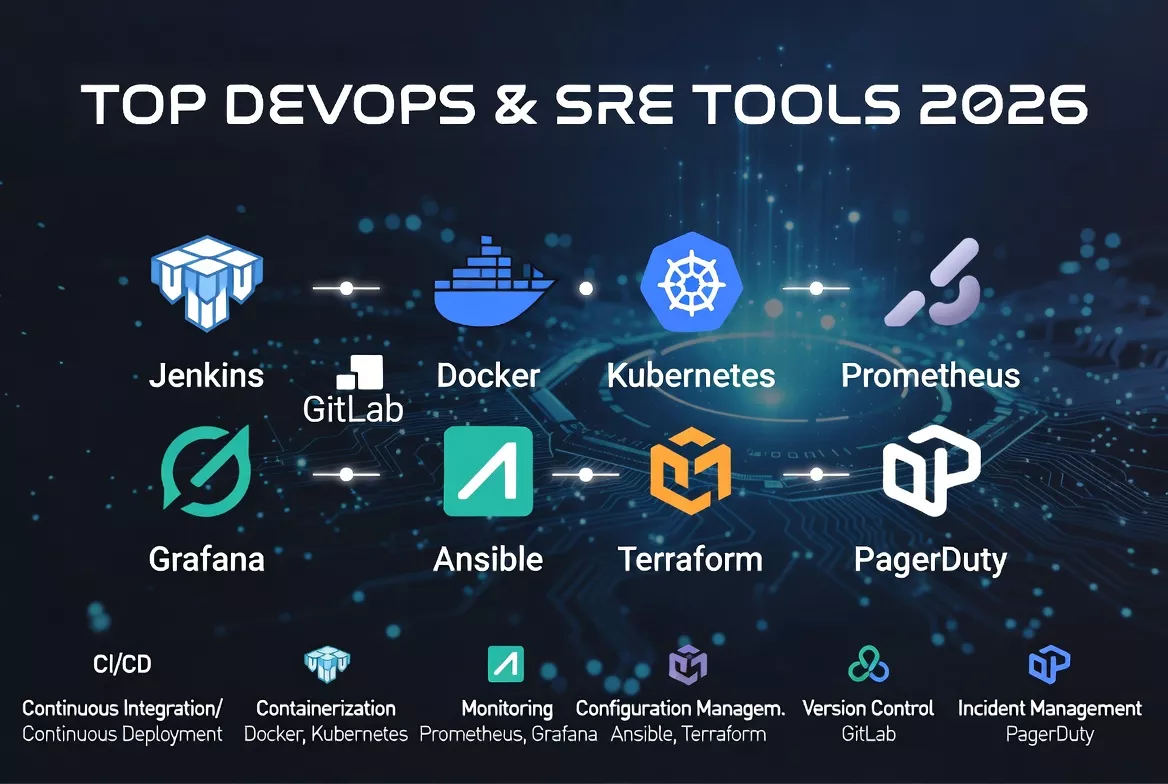
Whether you are starting your DevOps or SRE journey or planning your next career move, here are the most impactful tools to learn for job growth in 2026:
- Containers & Orchestration: Kubernetes, Docker
- IaC & Automation: Terraform, Ansible
- CI/CD & GitOps: Jenkins, GitHub Actions, ArgoCD
- Monitoring & Observability: Prometheus, Grafana, ELK
- Security: Snyk, Vault
- Incident & Reliability: PagerDuty, FireHydrant
Mastering these tools will make you job-ready for the evolving demands of DevOps and SRE careers — and position you for the most opportunities in 2026 and beyond.