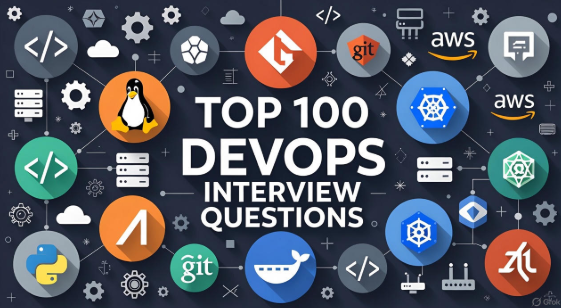
Top 100 DevOps Interview Questions (Linux, Git, Docker & Kubernetes)
Updated for 2025 | Beginner to Advanced | Real Interview Focus
DevOps interviews test not only tools but also problem-solving, automation mindset, and real-world experience. Whether you’re preparing for FAANG, product startups, or MNC DevOps roles, these Top 100 DevOps Interview Questions will help you crack interviews confidently.

This guide covers:
 Linux
Linux- Git & Version Control
- Docker & Containers
- Kubernetes & Orchestration
 Ideal for: Freshers, 2–10 years experience, Cloud & SRE roles
 LINUX INTERVIEW QUESTIONS (1–25)
Basic to Intermediate
- What is Linux and why is it widely used in DevOps?
- Difference between Linux Kernel and Linux Distribution?
- Explain the Linux directory structure (
/bin,/etc,/var,/usr). - What is the difference between soft link and hard link?
- How do you check CPU, memory, and disk usage in Linux?
- What is the use of
top,htop, andvmstat? - Explain
chmod,chown, andumask. - Difference between
grep,awk, andsed. - How do you find large files in Linux?
- What is a zombie process?
Advanced / Real-Time
- How do you debug high CPU usage on a production Linux server?
- What happens during Linux boot process?
- Difference between
cronandsystemd timers. - How do you monitor disk I/O bottlenecks?
- Explain inode and file system limits.
- What is swap memory? When should you increase it?
- How do you secure SSH access on Linux servers?
- What is
niceandrenice? - How do you find which process is using a port?
- Explain SELinux in simple terms.
- Difference between ext4 and xfs.
- How do you rotate logs in Linux?
- What is
straceused for? - Explain load average.
- How do you automate Linux tasks in DevOps?
 GIT & VERSION CONTROL QUESTIONS (26–45)
Core Git Concepts
- What is Git and why is it important for DevOps?
- Difference between Git and GitHub?
- Explain Git workflow.
- What is a repository?
- Difference between clone, fork, and checkout?
- What is
.gitignore? - Difference between commit and push?
- What is a branch?
- Difference between merge and rebase?
- What is HEAD in Git?
Advanced / Real-World
- How do you resolve merge conflicts?
- What is Git stash and when do you use it?
- Difference between
reset,revert, andcheckout. - What is cherry-pick?
- How do you undo a pushed commit?
- Explain Git hooks.
- What branching strategy do you follow in DevOps projects?
- How do you handle secrets in Git?
- What is a detached HEAD state?
- How do you secure Git repositories in CI/CD pipelines?
 DOCKER INTERVIEW QUESTIONS (46–70)
Docker Basics
- What is Docker?
- Difference between Docker image and container?
- What is a Dockerfile?
- Difference between
CMDandENTRYPOINT. - What is Docker Hub?
- What is containerization?
- Difference between VMs and Containers?
- What is
.dockerignore? - Explain Docker architecture.
- What is a Docker volume?
Advanced & Production Scenarios
- Difference between COPY and ADD.
- What is multi-stage Docker build?
- How do you reduce Docker image size?
- What is Docker networking?
- Difference between bridge and host network.
- How do you debug a failed Docker container?
- What is Docker Compose?
- How do you manage secrets in Docker?
- What is a dangling image?
- How do you scan Docker images for vulnerabilities?
- Explain container lifecycle.
- How do you persist data in Docker?
- What are Docker namespaces and cgroups?
- How do you optimize Docker for CI/CD?
- What are best practices for writing Dockerfiles?
 KUBERNETES INTERVIEW QUESTIONS (71–100)
Kubernetes Fundamentals
- What is Kubernetes?
- Why do we need Kubernetes?
- Difference between Docker Swarm and Kubernetes?
- What is a Pod?
- What is a Node?
- Explain Kubernetes architecture.
- What is kube-api server?
- What is etcd?
- What is a Deployment?
- Difference between Deployment and StatefulSet?
Advanced & Real-Time Kubernetes
- What is a Service in Kubernetes?
- Difference between ClusterIP, NodePort, and LoadBalancer.
- What is Ingress?
- What are ConfigMaps and Secrets?
- How does Kubernetes handle self-healing?
- What is HPA (Horizontal Pod Autoscaler)?
- How do rolling updates work?
- What is a namespace?
- How do you monitor Kubernetes clusters?
- How do you troubleshoot a pod in CrashLoopBackOff?
- What is liveness and readiness probe?
- How do you secure Kubernetes clusters?
- What is RBAC?
- What is Helm?
- Difference between Helm and Kustomize?
- What is a DaemonSet?
- How do you handle node failure?
- How do you manage secrets securely?
- What is Kubernetes CSI?
- Explain a real-time Kubernetes production issue you solved.
 Why This List Helps You Crack DevOps Interviews
 Covers 80%+ real interview questions Suitable for AWS, Azure, GCP DevOps roles Useful for Freshers + Experienced Professionals Ideal for CloudDevOpsJobs.com readers
 Final Tips for DevOps Interview Success
- Practice hands-on labs
- Explain answers with real production examples
- Focus on why, not just what
- Be strong in Linux + Kubernetes
Bookmark this page on www.clouddevopsjobs.com and revise before every interview.